

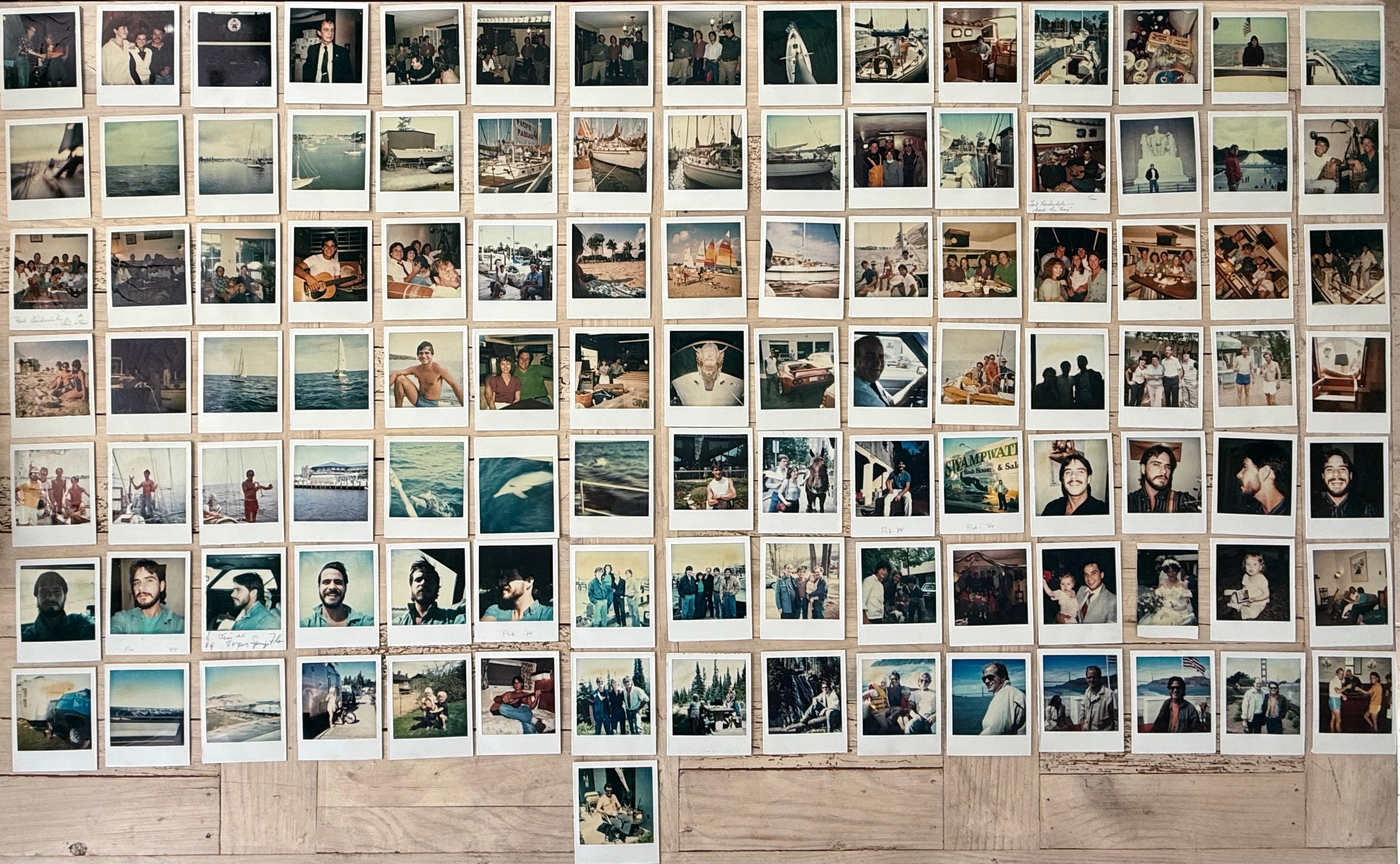
Polaroids from my 1982 Sailing Voyage from Newport to Key West and
“Pictures of You” Written as a demo in 2020 during the pandemic
You’ve seen the phrase beneath almost everything I create:
One Archive. One Hundred Years.
This week I’d like to tell you what it really means.
Because it isn’t just my archive I’m talking about.
It’s yours.
Mine began with the simple act of collecting things.
My mother was eighty-six when she died, and a year later I finally opened what she had left behind in her collection: her Bible wrapped in gold paper, every letter I had ever mailed her, my grandfather’s home movies flickering with the 1930s, and at the bottom, the manuscript she typed in 1971 but could never publish in her lifetime.
I thought I was opening a box of memories.
Instead, I was opening a century of questions.
Somewhere inside that collection lived the part of our family story that had never been fully told.
That’s the thing about an archive.
It isn’t a pile of old things.
It’s a hundred years of decisions.
Every object answers the same quiet question:
Of everything that passed through this life, what was worth keeping?
What it Means to Curate a Century
Curating an archive as diverse as mine—letters, paintings, reel-to-reel tapes, photographs, home movies, music, manuscripts—isn’t about organizing.
Organizing is what you do to a garage.
Curating is deciding what each object is evidence of.
The letter matters not because it’s old, but because it proves someone sat down, on a particular night, and chose those words for you.
A song demo from 2005 isn’t simply an early recording.
It’s a snapshot of who I was sitting at that kitchen table, carrying exactly that much hope into the future.
I’ve come to believe almost every family possesses an archive like this.
The generation that recorded the twentieth century on paper, film, and tape is handing those records to a century that stores everything but often struggles to preserve meaning.
We take hundreds of photographs of a birthday party and rarely print one.
Our grandparents took one photograph, framed it, and sixty years later it’s still telling its story.
For the first time in history, however, we also have tools capable of reconnecting these fragments instead of merely storing them.
A photograph leads to a letter.
A letter leads to a diary.
A diary leads to a forgotten song.
A song unlocks a memory no one realized still existed.
Used thoughtfully, artificial intelligence doesn’t replace our history.
It helps us rediscover it.
That’s the journey I’m on with SunTurtle Studios—not creating an artificial past, but curating a living collection from a very real one.
The Letters—and the Mirror
Somewhere in an attic near you there may be letters home from a young soldier in Europe.
Read them carefully and something remarkable happens.
Eventually they stop being about him.
A nineteen-year-old writing by flashlight about homesickness, uncertainty, and the girl he hopes to marry begins telling you something about yourself.
About the steadiness—or perhaps the silence—you inherited.
That’s the real power of any archive.
You look into someone else’s saved life, and it quietly asks questions about your own.
What did you save?
What does it reveal about what you were afraid to lose?
Ten Shots Per Cartridge
I learned curation long before I knew the word.
I learned it from a Polaroid camera.
On my own journey west I carried one with me, and a Polaroid was an honest teacher.
Ten exposures.
That was all you had.
Film cost money you didn’t have.
You couldn’t shoot a hundred pictures and sort them later.
You stood still.
You looked carefully.
Then you asked yourself one simple question:
Is this one of my ten?
Every surviving photograph became more valuable because of every photograph I never took.
There’s a Massachusetts story inside that camera, too.
Edwin Land built Polaroid in Cambridge, and after his daughter asked why she couldn’t see a photograph immediately, he spent years inventing the answer.
For decades Polaroid became synonymous with instant memory.
Families gathered around a photograph as it slowly appeared before their eyes.
Then digital photography arrived.
Pictures became free.
Within a generation we gained infinite images.
I’m not sure we gained infinite attention.
We became experts at taking photographs.
We became less practiced at deciding which ones truly mattered.
And perhaps the deciding was the art all along.
Why This Project Exists
People sometimes ask why I continue restoring old films, scanning letters, recording music, writing essays, preserving photographs, and finishing the stories my family couldn’t tell.
The answer is surprisingly simple.
Because memory is fragile.
Families don’t lose their history all at once.
They lose it one photograph…
one cassette…
one handwritten letter…
one forgotten story at a time.
SunTurtle Studios grew from my desire to preserve one family’s hundred-year collection.
Today I see it differently.
Every family has a museum.
Some museums are hanging on living room walls.
Some are packed into cardboard boxes in the attic.
Some are buried on forgotten hard drives.
Some exist only in the stories an aging parent still remembers.
The question isn’t whether your family’s collection exists.
The question is whether someone will become its curator before it’s too late.
That’s why I publish these essays each week.
If watching me open my family’s boxes inspires you to open yours, then this project is doing exactly what it was meant to do.
So here’s this week’s question—and I genuinely read every response.
What’s the one object in your family’s collection that you’d run back into a burning house to save?
And perhaps an even more important question:
What story does it still have left to tell?
— Tim, from the studio in the Valley of the Moon ☀️🐢
P.S. If you’re new here, welcome. Subscribe free, and I’ll send you an unreleased song, the opening pages of my forthcoming memoir, Taking the Helm: Compass and Tides, and two original paintings for your screen.
One Archive. One Hundred Years.
Because every collection begins with someone deciding that one thing was worth saving.