
I built my first studio in 1969, in the musty basement of our house in New Bedford, Massachusetts. I was just a kid. It smelled of damp fieldstone that oozed and leached in dribbles between the concrete cracks, and the smell of burning oil from the clunky furnace heating the ancient house above, where my seven siblings banged and bounced on the wooden floors. It was my sanctuary.
I made my first recordings down there on a reel-to-reel I received as a Christmas gift. I wrote songs in a notebook with a pen and listened to my 45s by the Beatles and the other artists of the Woodstock generation. That was the beginning of a lifetime of creating and collecting. I wrote my first songs in that studio and never stopped. There was no cloud; there was only a shoebox to keep those songs and tapes safe.
Fifty-odd years later, I sat in a different studio — this one in the Sonoma hills, three thousand miles west — and opened that shoebox of my life’s work. Letters. Photographs. Home movies. My mother’s manuscript. Reels and tapes and lyric sheets gone soft at the folds. An archive I’d been carrying, literally, from house to house, coast to coast, for decades without ever fully reading it. And when I finally laid it all out and began the slow work of turning it into something — sorting it, naming it, digitizing it, letting one piece talk to another — something happened.
I saw my own life from a different plateau.
Not from inside it, the way you live a life — head down, getting through the day, surviving the storm in front of you. From above it. I could see the whole path I’d walked, and the people and things I had loved along the way, and the shape of the thing I’d been building ever since that first studio in 1969. The process didn’t just preserve my history. It revealed it to me. It gave me the strange gift of meeting myself again.
That’s when it began to sink in.
Boomers, Gen X, and Millennials are the last generations born before the digital age, who both experienced and remember an analog world but grew and thrived in a digital one.
For my entire life, I have been collecting and preserving my analog heritage, not knowing exactly what I would do with it, and I know there are many people with similar archives.
The Journeyman Project is built around the idea that these archives and the stories they tell should be preserved as the last witnesses to that turning point in human history. A world I saw coming in the 1980s and helped build a bridge to today.
Last spring, I stood at MoMA in NYC with my daughter Grace, in front of a display case holding one of the first Macintosh computers ever sold at scale, the iconic 1984 “Big Brother” ad playing on a screen beside it. I didn’t just watch that revolution — I sold it. I sold those first Macs and the machines that followed, right up to the very first MacBook. In 1992, I was teaching a class at UMass on emerging technologies and helping to build a brand-new major: Business Information Systems. I hold the first BIS degree ever issued by the UMass system. We were selling the dream of a multimedia platform that could do almost exactly what I’m doing right now, as you read this — except it was the late 1980s, and the internet didn’t exist yet.
At the MoMA in NYC, talking to my daughter about selling Macintosh computers in the 1980s
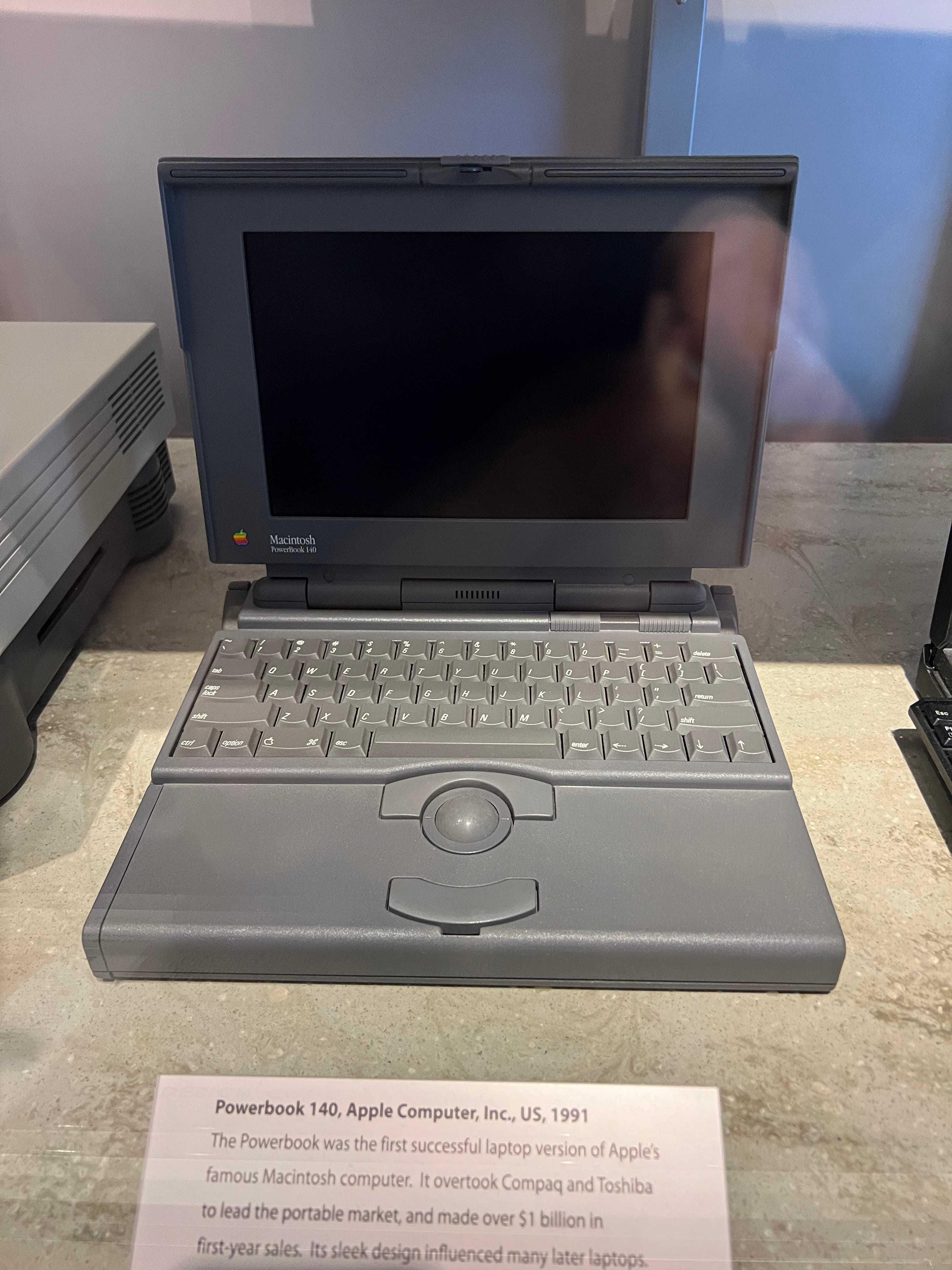
In 1992, I sold hundreds of Macintosh PowerBooks.
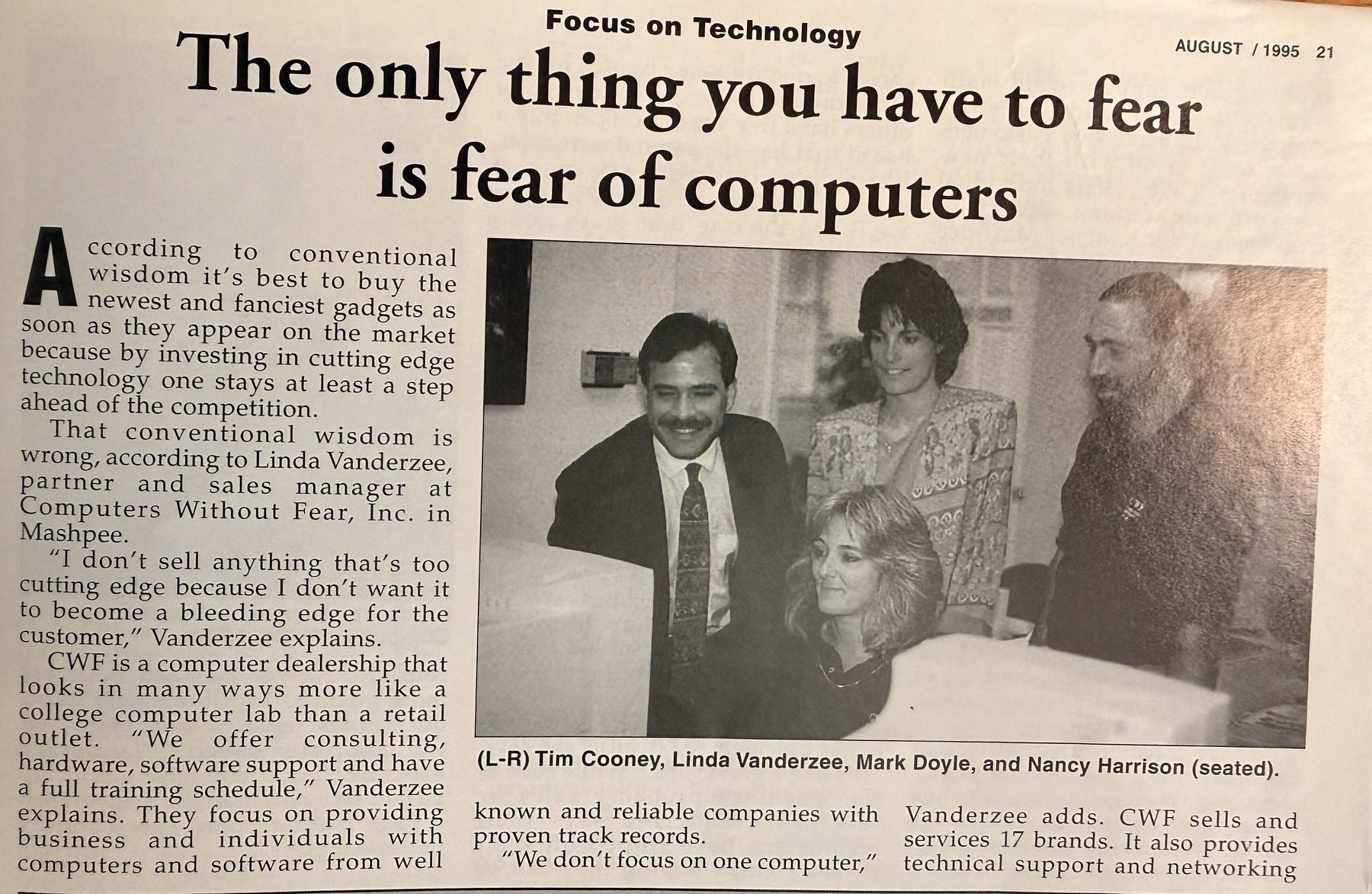
Computers Without Fear, Mashpee — August 1995. (That’s me, far left.)
Introducing The Macintosh 1984
It took forty years for the dream to become the tool. I wonder what Steve Jobs would think about the dream now. I can finally merge my archive and seamlessly create and recreate new forms of art, using it as an endless source for storytelling. And the same platforms that once felt like noise now carry those songs and images out to people I'll never meet.
Think about that for a second. If you remember recording songs off the radio, a rotary phone, a darkroom, a mixtape, the thunk of a car door before sensors and screens — if you remember being bored, genuinely bored, with nothing in your pocket to fill it but a harmonica — then you are part of something that is ending. Not your life. A condition. You were born into a world that existed before the digital age began, and you remember it. You can speak with authority because you lived in both eras.
The children born today — fifty years after we celebrated America’s bicentennial in 1976 — cannot. Never again will a human being arrive on this Earth untouched by, and uninfluenced by, the digital world we built in the last fifty years. From their first breath, it will be the water they swim in, invisible to them the way water is invisible to a fish. They will inherit it whole, and they will never know the before.
There is an irony in that, and a truth we have to sit with. The generation that built the digital world — the Boomers, Gen X, the Millennials who straddled the ages — is the last generation that will remember the world it replaced. We are the bridge. We have a foot on each shore. And bridges, eventually, are crossed and left behind.
Which means our archives are not clutter, they are the last record of a pivotal marker in the evolution of mankind. A generation on the fulcrum of a quantum leap in man's consciousness.
The shoebox in your closet, the slides in the carousel, the letters in your mother’s hand, the songs on a cassette labeled in pen — these are the last first-hand documents of a way of being human that is closing behind us. The ordinary, particular, fascinating lives — each one a curiosity in the human experience, each one a witness to mankind’s transition. Every person who remembers the pre-digital era is a primary source. And right now, in this narrow window, we finally have the tools to save it.
That’s the part that still surprises me. For the first time, the technology that’s erasing the analog world is also the thing that can preserve it. The same tools that let a song reach thousands of strangers overnight can take a basement full of fading tape and a box of brittle letters and carry them forward, intact, into whatever comes next. We can document the last analog generation using the digital one. We can hand our grandchildren not just our stuff, but our story — the texture of a world they’ll never touch.
Here’s what I learned down in that work: you think you’re organizing files. You’re actually meeting yourself. You think you’re preserving the past. You’re actually understanding it for the first time. All of it suddenly aligns and has purpose. And the dragon you’ve been carrying around from coast to coast — the unspoken things — it loses any power it once had the moment you write it all down and look at it after the long climb and from a higher plateau.
So this is the work I’ve created: to document and preserve these stories, mine and others’, before the last people who remember the pre-digital world are gone. I imagine a master archive of the last analog generation — Boomers, Gen X, Millennials, and the first digital children who can still hear the echo from their parents. To prove that a life’s worth of work in a drawer is not junk. It’s the last record of a race of people that is soon to be no more. And that’s a record worth saving.
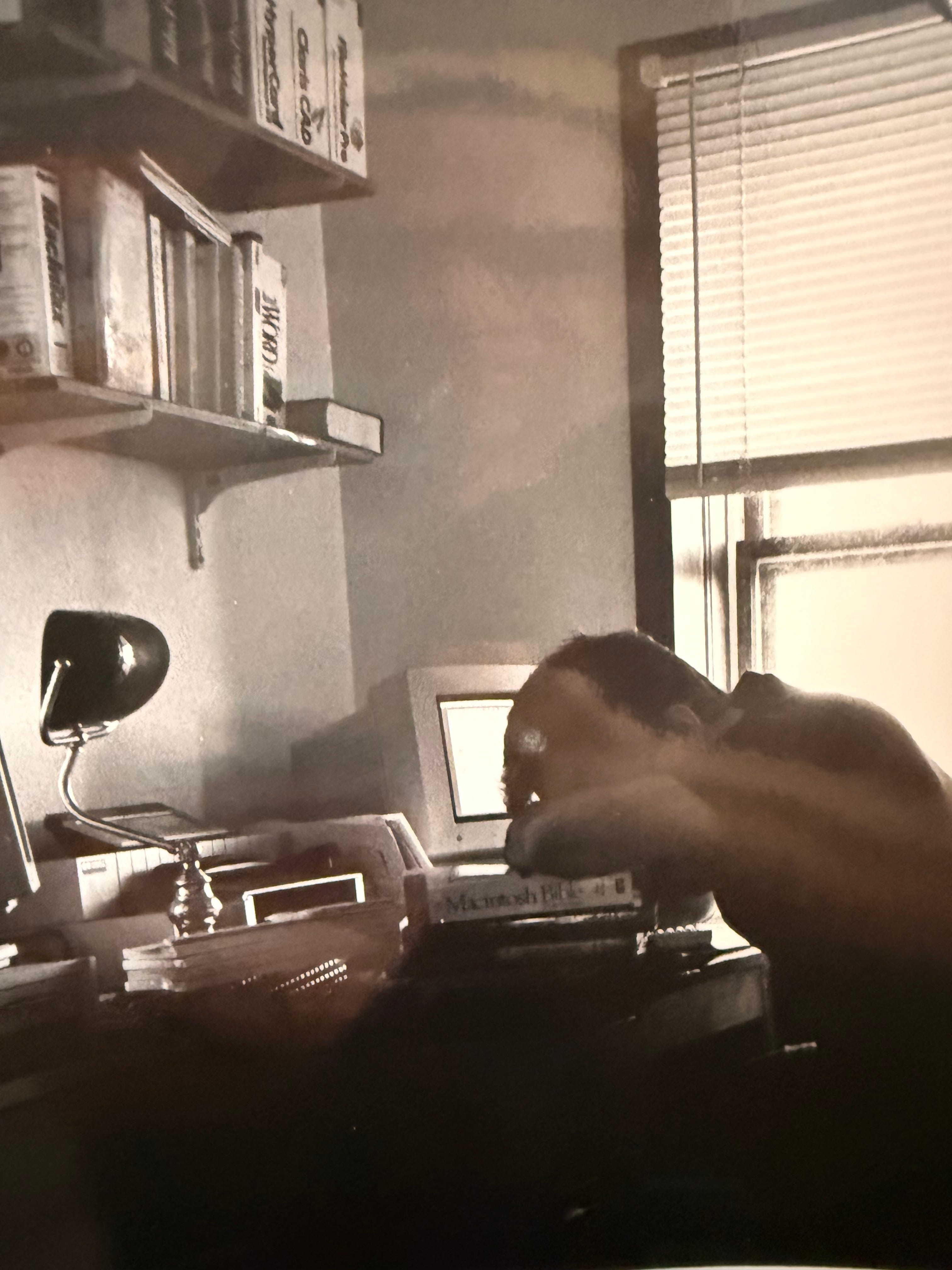
I built my first studio in a basement in 1969 because I had something I needed to get out of my head and into the world. I’m still doing it. The equipment changed. The mission, it turns out, never did. Here is a sample of how my shoebox became something else entirely.
Folk Singer from The Journeyman Vol I
If you’ve got a box of your own — open it. You might be surprised who you meet in there.
— Tim
This is the world of The Journeyman — the forthcoming memoir Taking the Helm: Compass and Tides and the soundtrack and archive around it. If you’re carrying a box of your own life and don’t know where to begin, stay close. That’s exactly the road I’m mapping. Join the crew — and come aboard.
In 1995, I was a consultant and teacher at a shop called Computers Without Fear — that's the clipping in the piece — selling people their first machines and, mostly, talking them down off the ledge. The fear was real back then. A computer felt like it might erase you, costing you a month's salary or more.
Thirty years later, the fear has flipped. Now it's the analog world we're afraid of losing — the shoebox, the cassette labeled in pen, the letter in your mother's hand.
So I want to hear yours. Answer either one:
— What was your first computer, and were you scared of it?
— What's the one analog thing in your closet you'd save first — the box, the tape, the photo — and whose voice is in it?
Tell me in the comments. I read each one. — Tim