
The Big Edit
Six months of finishing the book, a morning in Glen Ellen, and the lineage I didn’t know I was claiming.
It has been six months since I last wrote here, and there is a reason. We called it the Big Edit. Since December, Cindy and I have been working side by side, sentence by sentence, story by story, cutting the manuscript of Taking the Helm: Compass and Tides from 135,000 words to a little under 90,000. Six months at the table. Twelve chapters of structural revision. Two title changes. One throughline pulled taut until it sang. Finishing a book is a different discipline from drafting one. Drafting is invention. Finishing is judgment.
The original title was The Journeyman, and it carried the sense of a long, searching life. But as Cindy and I went deeper, the throughline became unmistakable. This was never just a journey. It was about the moments when I had to step forward, take responsibility, and make life-changing decisions in trauma and uncertainty — often without clear visibility, when the stakes were highest. The maritime metaphor I had lived for years at sea came into focus. Not decoration. Truth. The book moves across five generations, from Ireland to New England to California, through silence, loyalty, and the things families don’t say out loud. It is about what we carry, what we choose to leave behind, and whether love alone is enough — which, I have come to understand, it is not; but it’s all the hope we have. It is about taking the helm of a life when there is no land in sight.
The book is finished. Ninety thousand words. Every page earned. It is now with literary agents. So that is where I have been. That is what I have been doing.
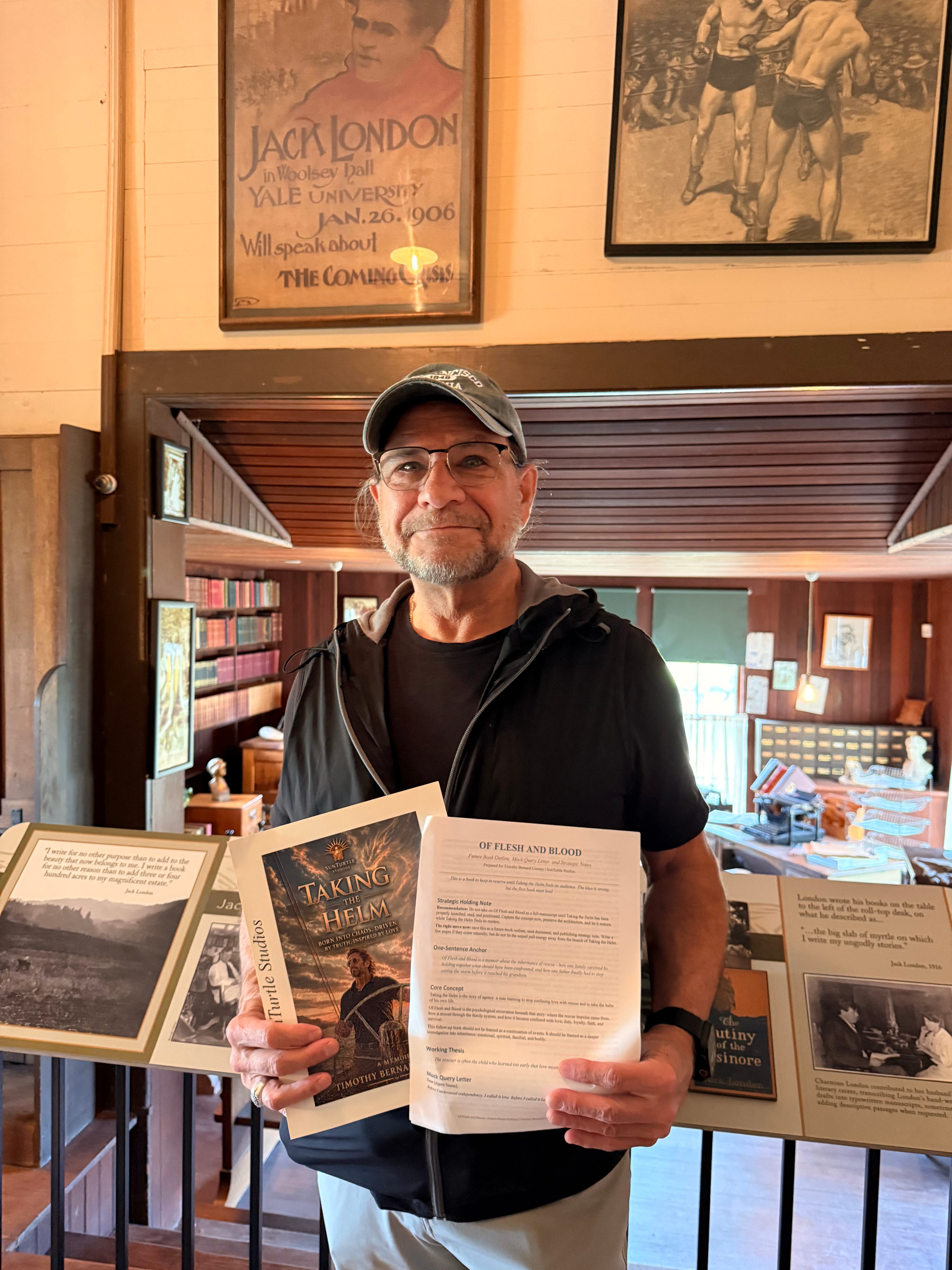
Yesterday, before the next phase of the work begins in earnest, Cindy and I drove to Jack London State Historic Park in Glen Ellen, just over the ridge from where we live. I look at those mountains every morning from the west side. Jack London looked at them every morning from the east. We had been sharing a horizon for a long time without my realizing it.
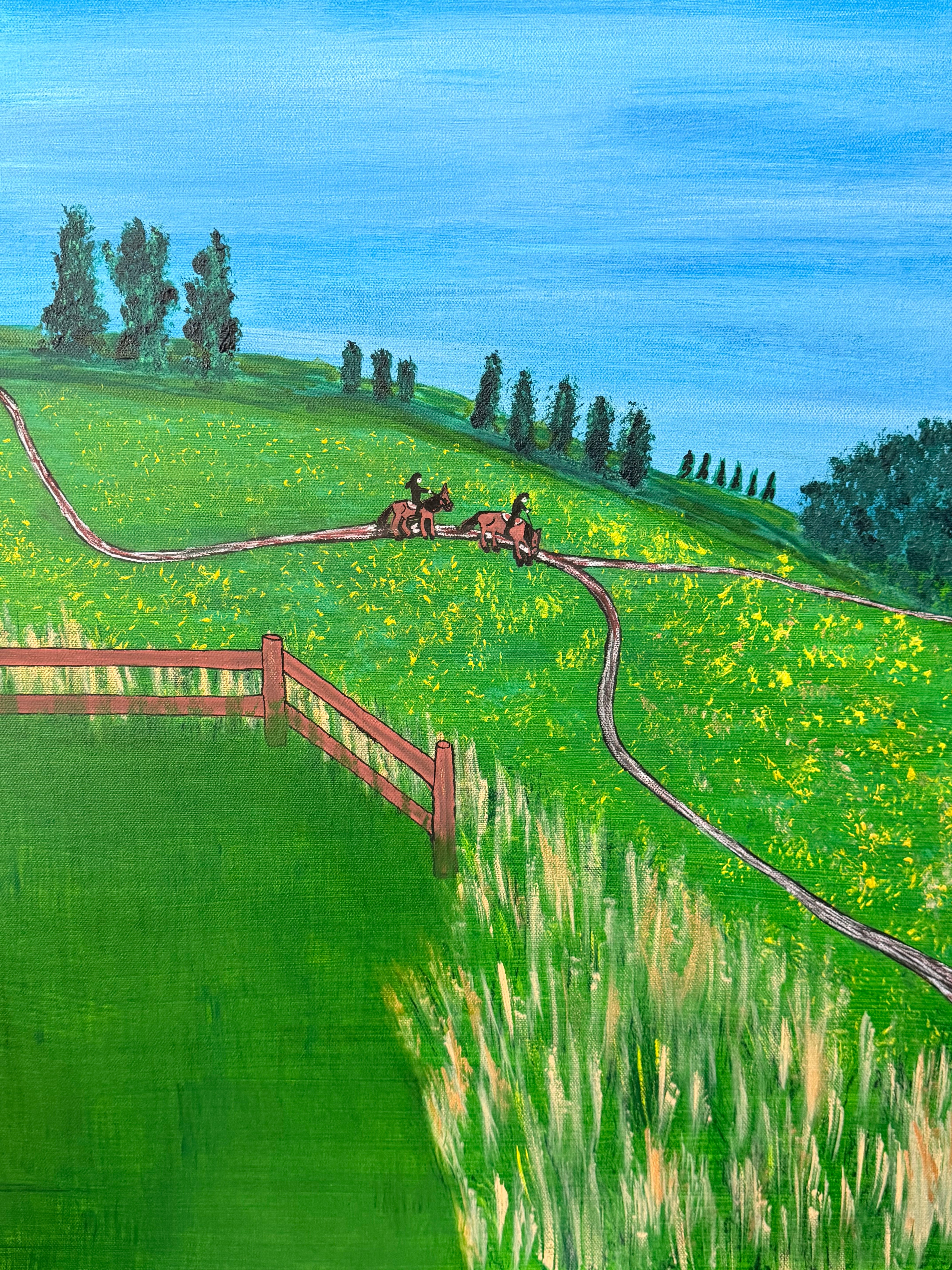
Home on the Range in Sonoma: The Sonoma hills, painted this spring during the Big Edit. The same range where Jack London used to ride, just outside my window in Petaluma, where I now live.
It was a return visit. Three and a half years ago, Cindy and I had walked the same grounds at the start of all this. On that first trip, I bought a biography called Jack London: An American Life, by Earle Labor. I went home, read it, saw myself in Jack’s story, and how he turned his suffering into art. I began to write, and one hundred and thirty-five thousand words came out of me. That book opened the door. Yesterday I came back to pay my respects with the finished manuscript in my hand, and I walked out with another book — Author Under Sail by Jay Williams— six hundred pages on Jack London's life as a writer and entrepreneur, his struggles with publishers and agents and fame, his thousand words a day for the rest of his life.
The cottage was open — the small house where he lived and died after Wolf House burned, the dream-house he had built and lost. His office still overlooks the same range of hills he wrote about and where he immersed himself in nature. I took video, took photos, walked the grounds slowly — I want to know what he knew.
It only struck me later, driving home, that the photograph on the cover of my own book — taken off Newport in 2013, twelve years before I had a manuscript to put under it — is itself a portrait of an author under sail. I had been one all along without knowing it, and Jack London has revealed that fact to me.
Two visits. Two books. Poetic, perhaps. Omens, more likely.
I have noticed, lately, that I keep arriving at the doorsteps of American letters by some quiet design. I lived in New Bedford for years, where Melville wrote about a white whale. I live now within view of the ranch where Jack London wrote Call of the Wild and died at forty. A Stanford English professor I watched recently asked a question I have not been able to shake. America, he said, has not produced a folk hero writer of London’s or Melville’s stature in over a hundred years. Whatever happened to men like that?
I am not making a claim. I am noticing a question. There are whole scholarly societies that dissect every word Jack London ever wrote, and what those scholars have always understood is that he wrote for his life, not just to pay the bills, but to stay alive. After everything I have been through, I read that, and I think: yes. That is the engine. Same stakes, same machine.
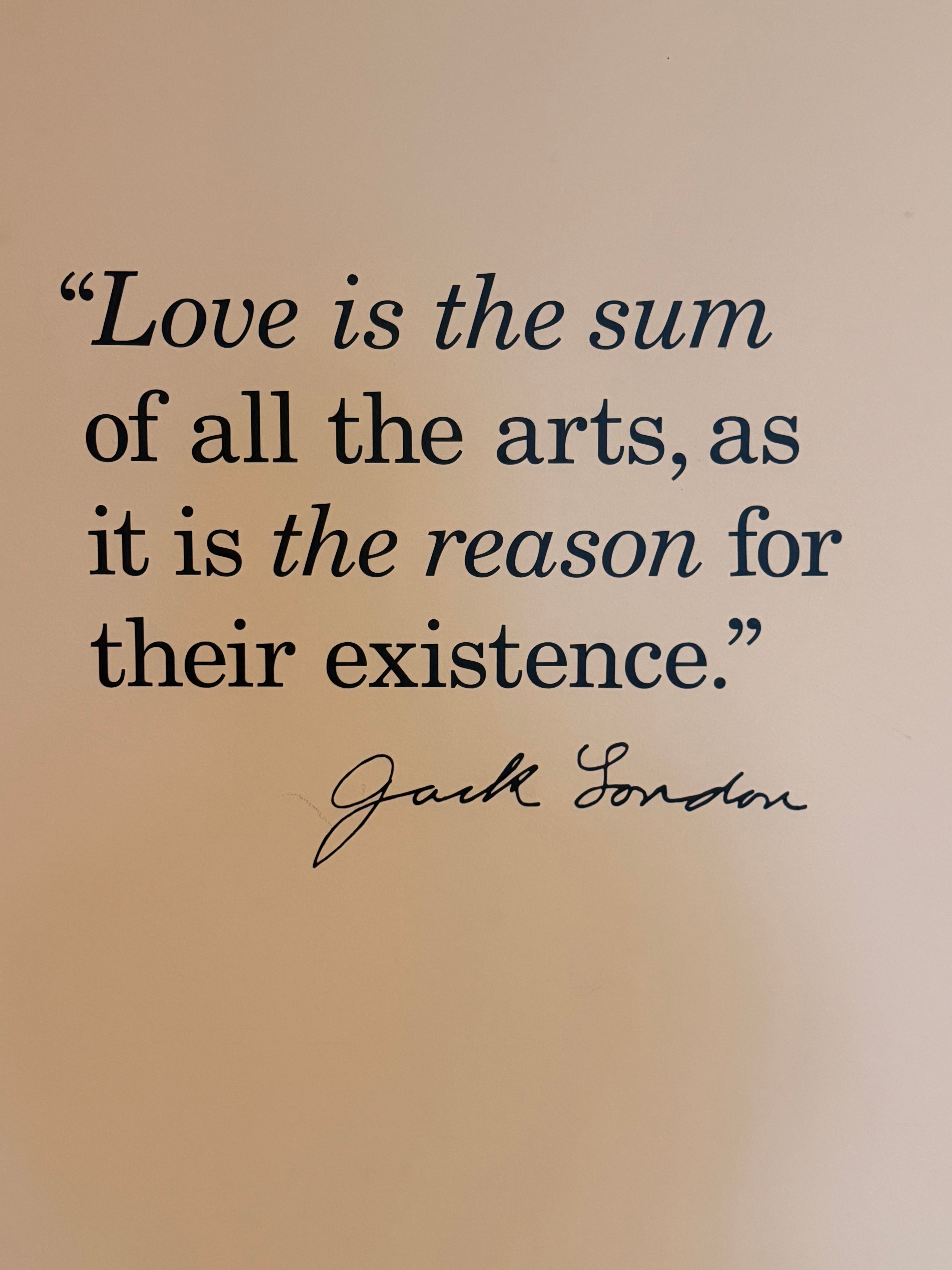
Then, on the wall of the museum, I found this:
“Love is the sum of all the arts, as it is the reason for their existence.”
— Jack London
I stood in front of it for a long time. The whole project — the memoir, the three-volume soundtrack, the paintings, the photographs, the family archive — is the sum of all the arts I have spent my life practicing. The book argues that love is the engine beneath it all, even when it is distorted into rescue and codependency. I didn’t know I was looking for that quote; it found me. It will be the epigraph of the book.
There was another thing Cindy and I learned at the museum that I cannot stop thinking about. After a broken first marriage, Jack London found Charmian Kittredge — strong, independent, fiercely her own person. She became his editor, his fiercest reader, his biggest supporter. He wrote beside her until the day he died. Charmian had been the engine behind everything he wrote in his last and best decade. Cindy and I read the placards and looked at each other, holding hands. After my own broken marriage, Cindy returned to my life 38 years after we last met— strong, independent, fiercely her own person — and became my editor, my fiercest reader, my biggest supporter. She has been beside me at every page of this book. Charmian. Cindy. Different centuries, different lives. Same engine. Same love.
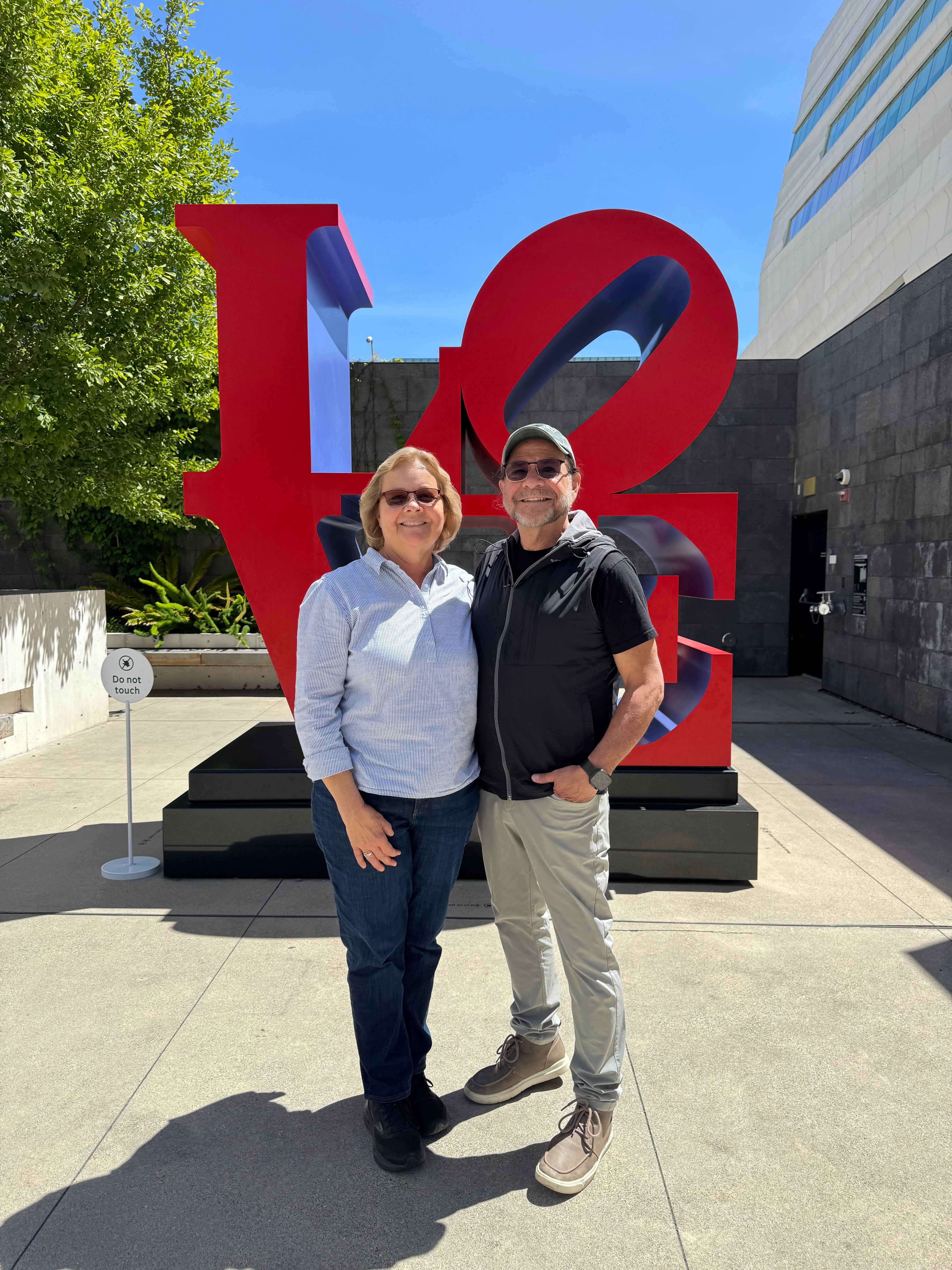
Tim and Cindy, the thesis of the book is in four letters.
Walking Jack’s estate at Glen Ellen, my phone buzzed twice in quick succession. Both of my sons called me on the same afternoon. Grant was on Cape Cod Bay, on a boat he had bought himself, carrying on the maritime tradition I had raised him in. Ben was on Martha’s Vineyard, fully employed, in affordable housing of his own, five months sober after fifteen years of bipolar disorder, addiction, and the long, slow ruin a parent watches when he cannot make it stop. The night before, my daughter Grace had called while she was driving back to New York from Cape Cod, her new Australian boyfriend beside her. She was on her way back to a life built on her dream of becoming a fashion designer, and at 22, she is living it at Calvin Klein. She told me she had never been happier. “I can’t believe this is my life,” she said. Three of my children, in twenty-four hours, from three different lives, had each found a way to take the helm and chart a course toward a life worth living. I stood on the path holding my phone in one hand and the copy of Author Under Sail in the other, and I understood, clearly, all at once, why I had been writing and that the book had revealed its truth.
The Big Edit is over. The manuscript of Taking the Helm – Compass and Tides is finished. It is now with literary agents who could change the trajectory of the next decade of my life. The waiting is its own kind of weather. I will hear back when I hear back.
After this book finds its audience, a second book awaits. Of Flesh and Blood will examine, from a decade’s worth of music, transcripts, paintings, writing, photography, and travel, how we arrived here — how love becomes rescue, how rescue becomes inheritance, and how we use art to tell our stories and build our own narrative. That is the next ship to leave the harbor. This one is preparing to set sail.
Yesterday, in Glen Ellen, on the property of one of the last great American folk hero writers, I got something that doesn’t need an agent’s permission. I got the epigraph for my book. I got three calls in twenty-four hours. I got a glimpse of what the chain looks like when it has finally been broken. And I came home with the woman who has been beside me at every page, who saw me before I saw myself, in the long tradition of Charmian and Jack.
I think Jack London would have understood.
— Tim Cooney
Glen Ellen, California · May 28, 2026
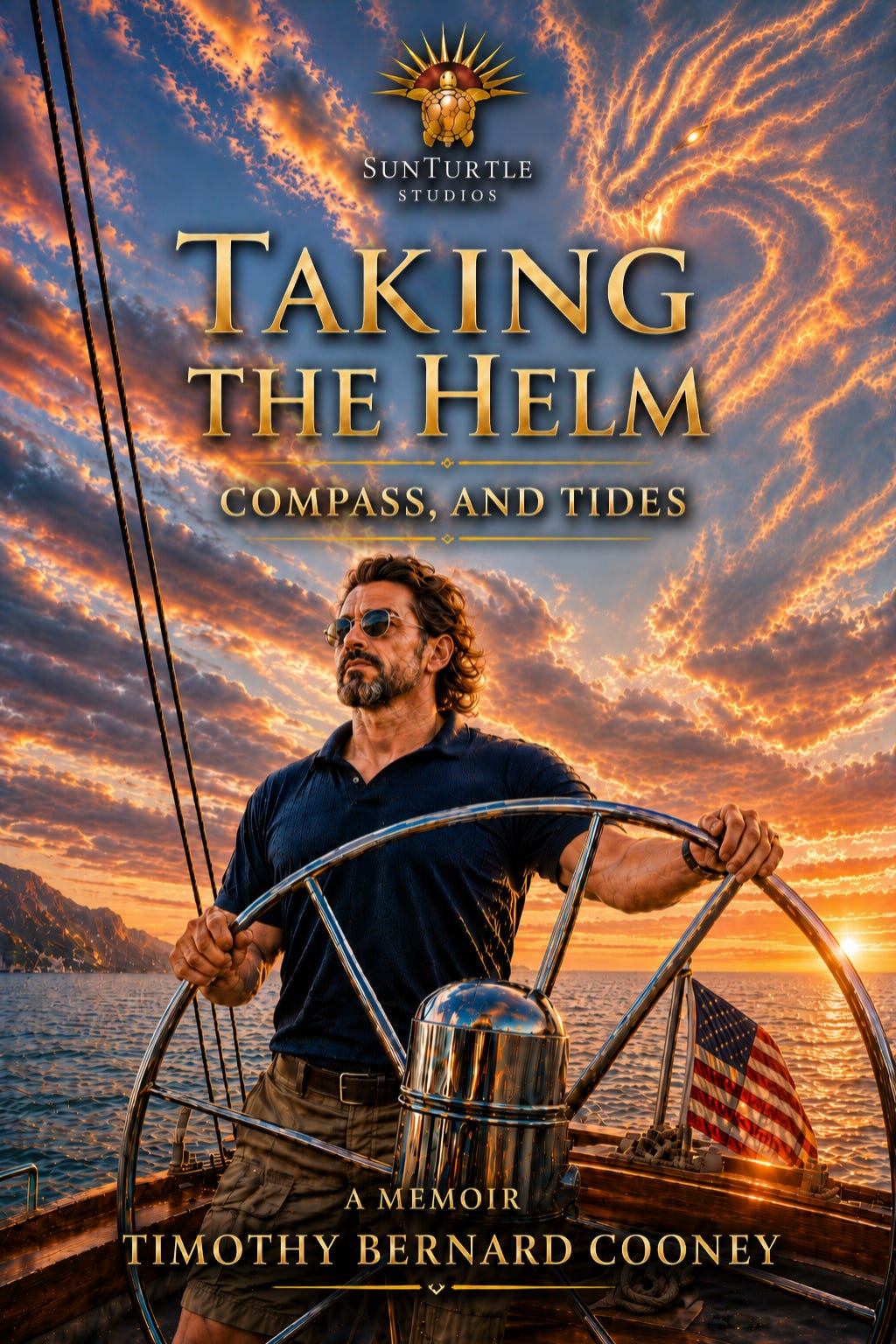
Cover concept for Taking the Helm: Compass and Tides. The final cover will be designed in collaboration with the publisher.— Tim Cooney
Tim sailing off Newport 2013
Glen Ellen, California · May 28, 2026

Dragon Slayer — New release from The Journeyman: Volume III
🎧 Dragon Slayer is part of Volume III, the closing movement of The Journeyman soundtrack, releasing alongside the memoir Taking the Helm: Compass and Tides.
The dragon in this song isn’t a monster from a fairy tale. It’s the one that camps outside your door and whispers I love you more — the voice of codependency and control, the inherited habit that “studies your fear” and “makes you seem small to keep you near.” This is the song where I stopped waiting for that dragon to leave and decided to face it.
It’s a fighting song, but the fight is a quiet one: early-morning meetings, a hike in the cold, keeping your word, telling the truth. Dragons hate daylight — so the sword here is honesty. And the bridge admits what anyone in recovery knows: the battle never really ends, because dragons can fly. You don’t slay this one once. You slay it every day.
I wrote it for the boy who still believes in his fate, and for everyone who comes after — slay it for your daughters and sons, for the legacy we leave. That’s the whole project in four lines: break the chain, so the next generation never has to.