

A post stopped me cold this summer. Forty-six years ago this June, John Lennon sailed out of Newport, Rhode Island, bound for Bermuda. Six months later he was gone.
I couldn't stop thinking about that harbor. Because Newport is where this story begins thrice — once with a guitar, once with a wheel — and once with me.
I. The Husband & Father Who Plugged In
July 25, 1965. Newport Folk Festival. Bob Dylan walks onstage with a Fender Stratocaster and a borrowed blues band and tears into "Maggie's Farm" — his first public electric set. Half the crowd cheers. Half boos. Someone later said he electrified one half of his audience and electrocuted the other.
The legend paints him as a rebel making a statement. His own memoir tells a quieter story. "I had a wife and children whom I loved more than anything else in the world," Dylan wrote in Chronicles. "I was trying to provide for them, keep out of trouble, but the big bugs in the press kept promoting me as the mouthpiece, spokesman, or even conscience of a generation."
He never asked for that job. The folk movement wanted him at the head of a parade, singing other people's battles in an approved voice, with approved instruments. Meanwhile the Beatles and everyone else were reaching for every new sound the studios could make, capturing the imagination of a generation — and Dylan had his own stories to tell and a family to feed. Plugging in wasn't a betrayal of the songs. It was loyalty to them. He refused to be left behind holding somebody else's banner.
Here's the detail I love most. When the crowd howled, and he came back out for an acoustic encore, he didn't have a harmonica in the right key — so he asked the audience for one. A clatter of harmonicas hit the stage. The same people booing the electric guitar threw their harmonicas at him. Then he played "Mr. Tambourine Man" and "It's All Over Now, Baby Blue," and walked off. He didn't return to Newport for thirty-seven years.
They booed the tool. They kept buying the stories.
“Like a Rolling Stone” is the song Dylan played when he picked up that tobacco-stained Fender Stratocaster.
This is an unforgettable version of Dylan's classic, played by old-time folk musician Jerome Rubin, who honors the song's gravity and scope. I don’t know the name of the other musicians, but I know the fiddle player just stepped up on stage at the last minute. Isn’t music great? Acoustic or electric.
From The Archive: Jerome Rubin covers Bob Dylan, “Like a Rolling Stone” Novato HopMonk Open Mic, 2024
II. The Man Who Took the Helm
Fifteen years later, June of 1980, the same harbor. John Lennon — five years into his silence, five years since he'd written anything he believed — stepped aboard a 43-foot boat called the Megan Jaye and sailed out of Newport for Bermuda. Six hundred thirty-five miles of open Atlantic. He'd barely sailed before in his life.
On the third day a storm found them. Twenty-foot seas, winds near sixty-five miles an hour. One by one the crew went down with seasickness and exhaustion — everyone but Lennon and the captain. And then the captain, who had been up too long, handed the wheel to a Beatle and told him, in essence: you've got to drive this little puppy, because I have to sleep. His instruction was six words long: "Focus on the horizon, not the compass."
Lennon steered alone for six hours, harnessed in, waves breaking over him. "I was buried under water," he said afterward. "I was smashed in the face by waves for six solid hours... I was screaming sea shanties and shouting at the gods! I felt like a Viking." He called it the time of his life.
He landed in Bermuda a different man. "I was so centered after the experience at sea that I was tuned in to the cosmos," he said. "And all these songs came!" In two months on that island, he wrote some thirty songs. Walking the Botanical Gardens one day, he saw a freesia labeled Double Fantasy and knew he had his album's name. It came out that November — his comeback, after five years of believing he had nothing left to say.
Three weeks later, on December 8, 1980, he was killed outside his home in New York. The storm gave him his voice back six months before the world lost it forever, or so we thought. That was before “Now and Then,” produced by the three surviving Beatles in 2023 using AI.
III. The Same Kind of Men
That summer of 1980, while Lennon was sailing out of Newport, I was just across the water on Cape Cod, moving into my first apartment in Hyannis to attend Cape Cod Community College — nineteen years old, out of my parents' house at last, my whole life ahead of me like open water. I didn't know a boat called the Megan Jaye had passed my horizon. I carried a brand-new Fender acoustic into that apartment — my high school sweetheart, Colleen, had worked a fruit stand all summer to buy it for me — and I was learning every Beatles and Dylan song I could hold, using music to break down barriers and make new friends.
Then, one Monday night that December, watching Monday Night Football with my roommates, Howard Cosell broke away from the game to tell us John Lennon had been shot and killed outside the Dakota. Everyone in the room was stunned. For me, it was personal. It shattered my senses. Everything his music had taught me about peace, love, and freedom went suddenly up for question, and something in me was lost — a sense of hope.
But his death didn't close a door. It started the seeking.
Two years later, almost to the season, I cast off from the same docks Lennon did.
September 22, 1982 — my twenty-first birthday. My friend Chris and I had spent the summer finishing a 36-foot sloop called the Amy, and we sailed her out of Newport Harbor bound for the East Coast run south, my father standing on the dock in his red Explorer jacket, arms crossed, saying almost nothing. I didn't know then that John Lennon had sailed out of that same harbor twenty-seven months before me. I only knew I was finally steering toward a life of my own.
A hundred miles off Long Island, a Nor'easter found us — the worst storm I've met in forty years of offshore sailing. Thirty-foot rollers, taller than the mast. On the midnight watch, harnessed in with rain pelting my face, I watched the tender I'd built all summer ride the crest of each wave thirty feet above my head, again and again, until the line snapped and she was gone into the dark, swallowed by the raging sea. The crew was below, waiting out their shifts. It was just me, gripping a cold, wet tiller, singing Beatles songs.
Many songs were sung as the hours passed. Cat Stevens came up out of the recesses of my mind: "Tea for the Tillerman" and "Miles from Nowhere." I sang it into the storm, gripping that tiller, gripped in fear and thrilled with exhilaration in the same breath.
I didn't learn until this month, researching this essay, what Lennon said about his six hours at the wheel in his own storm out of Newport: "I was screaming sea shanties and shouting at the gods." He had a wheel; I had a tiller. He was sailing to find his way back to his songs; I was sailing to find a way to write my own. Same harbor. Same kind of night. Same medicine. Little did we know it was all about the journey, and not the destination.
Both storms broke the same way, too. His ended in Bermuda, where thirty songs came pouring out. Mine ended at dawn on a sea gone smooth as glass, the whole crew silent in the cockpit with our coffee, watching the Manhattan skyline shimmer to starboard as we slid down the Jersey coast. I didn't think of it then, but we were gliding past the city where, twenty-one months earlier, outside a building called the Dakota, the man from the Megan Jaye had run out of time.
Dylan got into my blood even earlier. The harmonica I play came down that bloodline — the man who asked a hostile crowd for a harmonica and got a stage full of them. Every song I've written owes something to a storyteller who refused to let anyone else decide what his stories were for.
Years later — decades — my son Grant took his own boat out on her maiden voyage. I was in California, three thousand miles from that harbor, watching him motor out on a phone screen held up to the wind. My father saw me off from a dock in his red Explorer jacket, arms crossed, saying almost nothing. I saw my son off over FaceTime, and gave him the only blessing I had: "Keep your eyes on the horizon — but don't lose sight of your compass."
Different dock, different tool. Same farewell.
I had never heard Captain Hank Halstead's words to Lennon when I said it. I found them only this month, researching this essay, and the hair on my arms stood up. An old sailor's instruction, passed to a new one, decades apart, almost word for word — except mine holds both. The horizon is where you're going. The compass tells you how to get there. You need them together, because vision without bearings is drift, and bearings without vision leave you going in circles.
IV. Dylan Going Electric Was Never the Story
I use new tools to tell my stories — including tools some people believe no storyteller should touch. I write my songs and books with my own hands and my own years, and then I use every instrument this moment offers to give the stories their music, their pictures, their reach. Some folks boo that. I understand them, truly — the folk purists at Newport loved something real, and so do the purists now, but even back then, it didn’t have to be one or the other.
I keep thinking about a song called "Now and Then" — a real John Lennon vocal, sung into a cassette machine in that same last chapter of his life, finished four decades later by his bandmates with tools that didn't exist while he lived. When it arrived, the world didn't boo. The world wept. Because it was never about the technology. It was his voice. It was the story, finally reaching safe harbor.
From cave walls to the printing press to a Stratocaster in Newport to a rescued cassette, every generation's storytellers have picked up the tool the purists distrusted. They had to. The lives we live grow more astonishing with every generation, and the human spirit demands that the telling keep up. The tool was never the story. The story remains the same: a family, a legacy, and a man at the helm.
Dylan didn't explain himself at Newport. He just played for his life, and his life is why he played. The Beatles didn’t explain why they used AI to reunite with the lost leader of their band; they just did it while we wept for their loss and ours. The story didn’t change because they rescued his vocals from a lost cassette tape and created a new song for us to know and love.
Here is my own version of “Now and Then” performed with The SunTurtles in Novato in 2023
From the Archive: The Beatles “Now and Then” covered by Tim and the SunTurtles, 2023
V. Strawberry Fields
My memoir ends in Central Park, at Strawberry Fields — Lennon's memorial, the Imagine mosaic. I walked there with my daughter Grace, Grant's twin, and told her about John Lennon, about how the Beatles shaped my young life and taught me how to dream. I told her to imagine her future and let it unfold naturally, as if the story had already been written. And then she surprised me: sitting on a bench near the mosaic, she asked me to tell her about my book — and about my father, who died before she was born.
I wrote that ending before I ever knew about the Megan Jaye. Before I knew Lennon had literally taken the helm in a storm and steered himself back to life and song, six months before the end. Before I knew, his captain's words were nearly my own.
Some rhymes you don't compose. You just finally hear them.
Dylan took the helm of his own future in that harbor and let the crowd boo. Lennon took the helm of a small boat in a big storm and got his voice back. I took the helm of a hundred years of family story, with every tool I could carry aboard.
We are the same kind of men — the ones who, when the storm comes and the crew goes down, we take the helm.
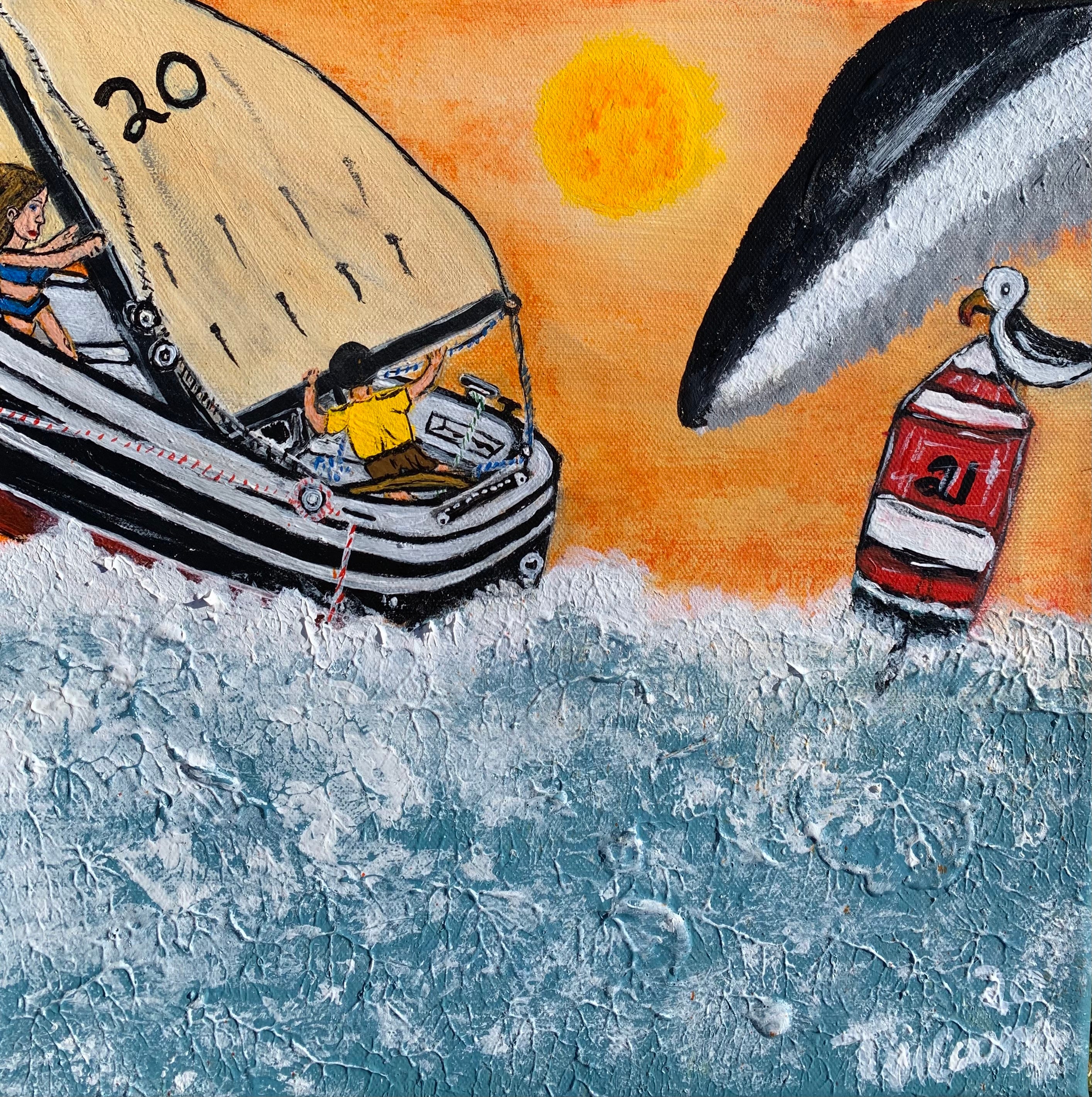
🎁 Subscribe free, and I'll send you a welcome gift: an unreleased song, the opening pages of my memoir Taking the Helm, and two paintings for your screen: thejourneyman1.substack.com/subscribe
Tim Cooney, ☀️🐢 SunTurtle Studios® · Valley of the Moon 🌙 · 1 Archive – 100 Years
A question for you: have you ever changed your tools mid-voyage — new career, new craft, new anything — when the old ones still worked? What did it cost you? I read and answer every comment here.